
Cover Letters: How to Get Past ATS and Impress Hiring Managers
Cover letters give you space to explain why your experience fits a specific job. A strong letter does not repeat your resume. It connects your most relevant achievement to the employer’s needs and gives the hiring manager a clear reason to keep reading.
What is a cover letter?
A cover letter is a short document submitted with your resume. It introduces you to the employer, highlights the experience most relevant to the open position, and explains why you want to work for that organization.
Your resume shows the broader record of your skills, responsibilities, and results. Your cover letter adds context. It can explain why one achievement matters, how your background connects to a new industry, or why a particular company and role make sense as your next step.
The best cover letters answer three questions quickly:
- Why are you interested in this specific position?
- What evidence shows that you can do the work?
- Why does your experience make sense for this employer?
If the letter could be sent to ten different companies without changing anything except the name, it is probably too generic.
Do cover letters still matter?
Not every employer requires a cover letter, and hiring teams do not all use them in the same way. However, a well-written letter can strengthen an application when the job asks for one, when your experience needs context, or when you have a specific reason for wanting the role.
A cover letter can be especially useful if you are changing careers, returning to work, applying with limited direct experience, relocating, or pursuing a role where writing and communication are important. It also gives you an opportunity to feature one strong example that might be easy to miss in a resume.
If the application says a letter is optional, submit one only when you can make it specific and useful. A rushed, generic letter rarely adds value. If the employer says not to include one, follow the instruction.
How to structure a cover letter
Most effective cover letters follow a simple, one-page structure. You do not need an elaborate design or a long personal story. Use clear paragraphs, standard business formatting, and direct language.
- Contact information: Include your name, city and state, phone number, professional email address, and LinkedIn profile or portfolio when relevant.
- Date and employer details: Add the date, hiring manager’s name if known, company name, and company location.
- Greeting: Use “Dear Jordan Lee” or “Dear Hiring Manager.” Avoid guessing a person’s title or gender.
- Opening paragraph: Name the position and establish your strongest connection to the role.
- Evidence paragraph: Describe one or two relevant achievements, including a result when possible.
- Company-fit paragraph: Explain what attracts you to the organization, product, mission, customer, or challenge.
- Closing: Reaffirm your interest, thank the reader, and invite a conversation.
Keep each paragraph focused. Three to five short paragraphs are usually easier to scan than one large block of text.
A simple formula for writing cover letters
When you are unsure where to begin, build the letter around this sequence:
Role + relevant strength + proof + company connection + next step
For example:
“I’m applying for the Customer Success Manager position because my background combines SaaS onboarding, account retention, and customer education. At Northline Software, I redesigned the onboarding process for mid-market clients and helped reduce first-90-day churn by 18%. I’m especially interested in your focus on helping small businesses adopt complex tools with less friction.”
This opening identifies the position, establishes relevant experience, provides measurable evidence, and shows a specific connection to the employer. It gives the hiring manager useful information immediately.
Cover letter example 1: Experienced professional
This example is written for a senior product designer applying to a financial technology company. Notice how the letter selects one relevant project instead of summarizing every position on the resume.
MAYA RODRIGUEZ
Miami, FL | (305) 555-0184 | maya.rodriguez@example.com | mayarodriguez.design
August 17, 2026
Alex Chen
Director of Product Design
HarborPay
New York, NY
Dear Alex Chen,
I’m applying for the Senior Product Designer position at HarborPay because my background centers on making complex financial experiences easier to understand and complete. Over the past eight years, I have designed account, billing, and payment products across responsive web and native mobile platforms while partnering closely with research, engineering, accessibility, legal, and product teams.
At Meridian Mobile, I led the redesign of a digital wallet experience used by more than two million customers. Research showed that users were uncertain about available balances, payment timing, and confirmation states. I simplified the information hierarchy, introduced clearer status messaging, and worked with engineering to create reusable payment components. After launch, successful wallet transactions increased by 14%, and payment-related support contacts decreased by 11%.
HarborPay’s focus on giving small businesses clearer control over cash flow is especially meaningful to me. Your recent work on real-time payment tracking addresses the same trust problem I have encountered in consumer billing: people need to know what happened, what happens next, and what action is required. I would be excited to bring my experience in financial workflows, design systems, and accessible interaction patterns to that challenge.
Thank you for considering my application. I would welcome the opportunity to discuss how I could contribute to HarborPay’s product team.
Sincerely,
Maya Rodriguez
Why this cover letter works
- It opens with relevance: The first paragraph connects the candidate’s financial-product background to the position.
- It provides evidence: The second paragraph describes the problem, the candidate’s contribution, and two measurable results.
- It shows company knowledge: The third paragraph refers to a specific product challenge instead of offering generic praise.
- It complements the resume: The letter adds a short case study rather than repeating a list of job duties.
Cover letter example 2: Entry-level applicant
This example shows how an applicant with limited direct experience can use transferable skills. The candidate connects retail work and a school project to an entry-level marketing coordinator position without overstating her background.
JASMINE PATEL
Orlando, FL | (407) 555-0139 | jasmine.patel@example.com | linkedin.com/in/jasminepatel
August 17, 2026
Hiring Manager
BrightPath Learning
Orlando, FL
Dear Hiring Manager,
I’m excited to apply for the Marketing Coordinator position at BrightPath Learning. As a recent communications graduate with hands-on experience creating social content, coordinating promotions, and working directly with customers, I can bring strong organization and a clear understanding of audience needs to your marketing team.
In my role at Lakeside Market, I helped plan and promote monthly in-store events across Instagram, email, and printed signage. I organized the content calendar, gathered product information from department leads, and tracked attendance in Excel. Over four months, average event attendance increased from 35 to 52 customers. The experience taught me how to manage deadlines, keep details accurate, and adjust messaging based on customer response.
For my senior capstone project, I also worked with a four-person team to create a recruitment campaign for a local literacy nonprofit. I interviewed volunteers, developed audience profiles, wrote campaign copy, and presented our recommendations to the organization’s director. BrightPath Learning’s goal of making educational support more accessible is closely connected to the kind of mission-driven work I hope to continue.
Thank you for your time and consideration. I would be glad to discuss how my communication skills, project experience, and willingness to learn could support BrightPath’s upcoming campaigns.
Sincerely,
Jasmine Patel
Why this cover letter works
- It does not apologize for limited experience: The candidate leads with relevant abilities instead of focusing on what she lacks.
- It translates transferable skills: Retail promotions become evidence of content planning, coordination, measurement, and customer understanding.
- It includes a real result: The attendance increase makes the example more credible and specific.
- It adds academic evidence: The capstone project supports the skills needed for the target role.
How to tailor cover letters for each job
Start with the job description. Highlight the responsibilities, skills, tools, customers, and outcomes that appear most important. Then choose evidence from your background that matches those priorities.
- Use the exact job title. This confirms that the letter was written for the correct position.
- Select two or three relevant qualifications. Do not try to address every line of the posting.
- Support your claims. Replace “I am results-driven” with a concise example of a result you produced.
- Add a real company connection. Refer to a product, customer group, mission, initiative, or business problem that genuinely interests you.
- Use keywords naturally. If the posting emphasizes “customer onboarding,” “Salesforce,” and “retention,” include those terms only when they accurately describe your experience.
- Review the names. Confirm the employer, hiring manager, and position before submitting.
A practical approach is to keep a master letter containing several strong achievements, then select and rewrite the most relevant material for each application. Do not submit the master version unchanged.
Are cover letters scanned by ATS software?
Some Applicant Tracking Systems store cover letters with the rest of the application and may make their text searchable to recruiters. The exact process varies by employer and software configuration. That is why a cover letter should use clear, editable text and standard formatting.
Keywords can help establish relevance, but repeating phrases from the job posting is not a substitute for evidence. Use the employer’s terminology when it truthfully matches your background, then show how you used that skill or delivered that outcome.
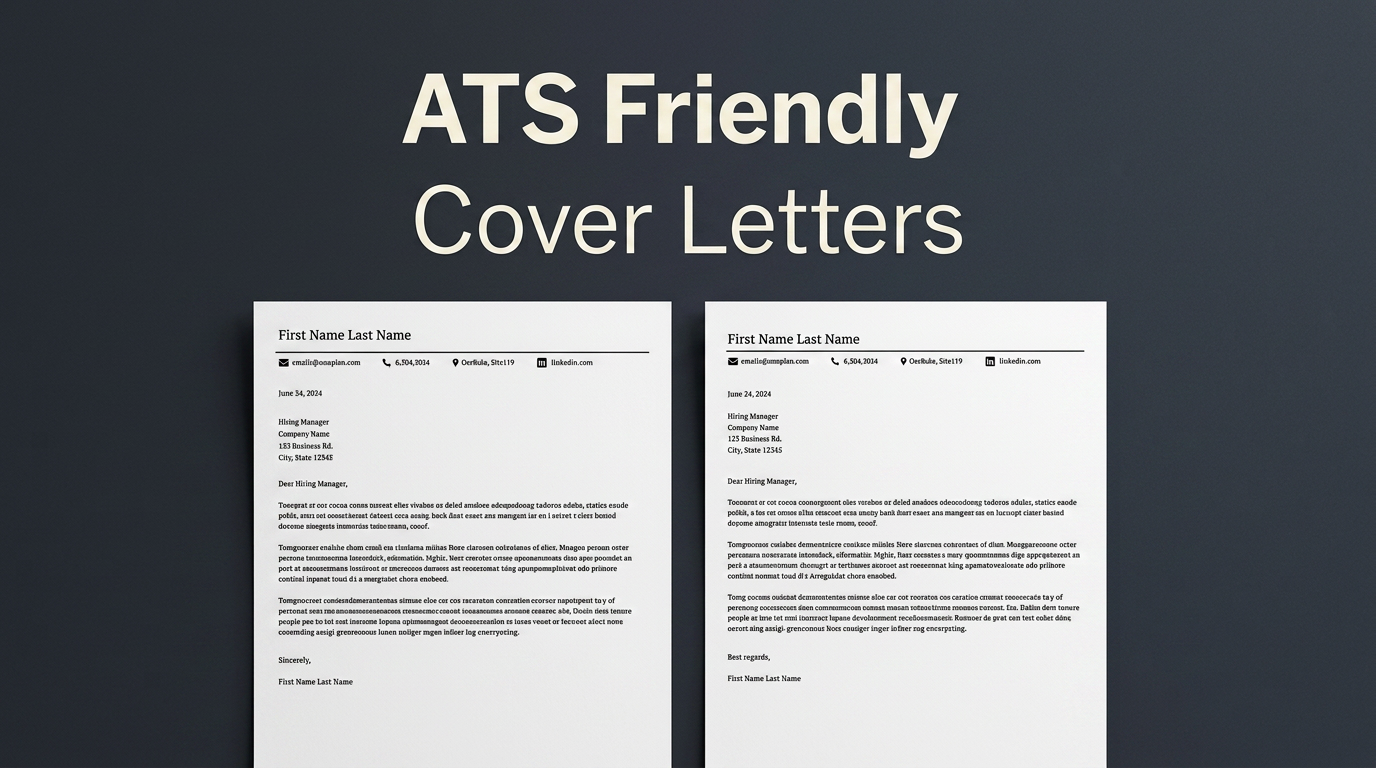
- Use a simple one-column layout
- Choose a common, readable font
- Avoid placing important text inside images, charts, or decorative graphics
- Use the file type requested by the employer
- Name the file clearly, such as Rodriguez_Maya_Cover_Letter.pdf
- Proofread the exported document before uploading it
Your cover letter and resume should also support each other. After tailoring the letter, check your resume score for free and confirm that your most important qualifications appear in the resume itself.
How long should a cover letter be?
A cover letter should usually fit on one page. Aim for approximately 250 to 400 words, divided into three to five short paragraphs. The ideal length is long enough to provide specific evidence but short enough for a hiring manager to scan quickly.
Do not reduce the font to fit a long letter onto one page. Edit the content instead. Remove repeated resume details, long explanations, and sentences that could apply to any applicant. Keep the strongest example and the clearest reason for your interest.
Common cover letter mistakes to avoid
- Repeating the resume instead of adding context
- Opening with generic claims such as “I am the perfect candidate”
- Describing only what you want without addressing the employer’s needs
- Listing soft skills without examples
- Using the wrong company name, job title, or hiring manager
- Writing one dense block of text with no paragraph breaks
- Including personal information that is not relevant to the role
- Copying a sample word for word
- Submitting a letter generated by AI without checking its accuracy and tone
Templates and examples should guide your structure, not replace your own experience. Every achievement, tool, credential, and result in the final letter must be accurate.
Can you use AI to write a cover letter?
AI can help you organize ideas, compare your experience with a job description, shorten a draft, or identify vague language. It works best as an editing tool, not as the source of your professional history.
Before using AI, remove sensitive personal or company information you should not share. After generating a draft, verify every claim and rewrite the language so it sounds like you. Delete exaggerated statements, invented metrics, generic praise, and details that you could not explain in an interview.
A useful prompt might be: “Using only the experience below, help me draft a 300-word cover letter for this position. Focus on my experience with customer onboarding and retention. Do not invent skills or results. Mark any missing information with brackets.”
Frequently asked questions about cover letters
Should I write a cover letter if it is optional?
Write one when you can add specific evidence, explain a career transition, or show a meaningful connection to the role. Skip a generic letter that only repeats your resume.
Who should I address a cover letter to?
Use the hiring manager’s full name when you can verify it. If you cannot, “Dear Hiring Manager” is professional and clear. Do not guess a name or title.
Should a cover letter repeat resume keywords?
Use relevant job-description terms naturally when they match your experience. Include them inside specific examples rather than copying a keyword list into the letter.
What should I include if I have no direct experience?
Focus on transferable skills supported by work, school, volunteer, freelance, or personal-project examples. Show what you did, how you approached it, and what result followed.
Should I submit a cover letter as a Word file or PDF?
Follow the application instructions. When no format is specified, a properly exported, text-based PDF usually preserves the layout well. Keep a Word version available in case the employer requests one.
Can I use the same cover letter for every job?
Use a master draft as a starting point, but tailor the opening, evidence, keywords, and company connection for every application.
Write the letter, then check the resume
Strong cover letters make a focused case for your fit. Name the role, lead with relevant experience, support your claims with evidence, and explain why the employer’s work interests you. Keep the final letter concise, accurate, and easy to read.
Before submitting your application, make sure the resume contains the qualifications and keywords that support the story told in your letter.
Check your resume before you apply
Scan your resume for missing keywords and common formatting issues, then submit it with a cover letter tailored to the position.